In 2026, businesses are facing unprecedented challenges and opportunities.
AI-driven automation, hybrid work, and the accelerating pace of change continue to reshape how organisations operate. And yet, in the midst of all this transformation, one truth remains:
Business success is still built on relationships.
But there’s something else becoming increasingly clear.
It’s not just relationships that matter —
it’s our ability to work with them when they get difficult.
Because where there are relationships… there is conflict.
What Is a Relational Business — Really?
A relational business doesn’t just value connection when things are going well.
It builds the capacity to stay in relationship when things get challenging.
Rather than focusing purely on efficiency or outcomes, relational businesses invest in:
- Trust-based, long-term relationships
- Open, honest communication
- Shared responsibility across teams
- The ability to navigate difference and tension productively
Because high performance isn’t about avoiding disruption.
It’s about knowing how to move through it.
Why Relationship Systems Matter More Than Ever
We no longer operate in simple, linear environments.
Teams are more distributed.
Work is more complex.
Expectations are higher.
And increasingly, what gets in the way isn’t strategy — it’s relationships.
A relationship system (a team, organisation, or partnership) is dynamic and constantly evolving.
It holds:
- Different perspectives
- Competing priorities
- Unspoken assumptions
- And often — unresolved tensions
Leaders and coaches who can work with this complexity don’t just manage performance.
They unlock it.
The Missing Capability: Working with Conflict
Recent data shows that workplace conflict is rising — and costing UK businesses billions each year.
But the real shift we’re seeing isn’t just in the presence of conflict.
It’s in how organisations are responding to it.
As our Director Nairy McMahon recently shared in The Sunday Times:
“They’re aware that conflict is an inevitable consequence of us working together. If we want high-performing teams, we need to facilitate that conversation.”
The most forward-thinking organisations aren’t waiting for conflict to escalate.
They’re building the capability to work with it from the start.
Introducing Relationship Systems Intelligence (RSI™)
In the same way Emotional Intelligence reshaped leadership, Relationship Systems Intelligence (RSI™) is redefining how we work with teams and organisations.
RSI™ helps you:
- See beyond individuals and understand the system as a whole
- Recognise and work with the emotional field of a team
- Navigate conflict as a source of insight, not disruption
- Create alignment and shared ownership
This is the foundation of modern leadership.
How ORSC Supports This Shift
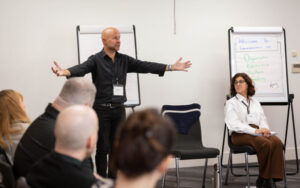
At CRR UK, we don’t just teach these ideas — we create spaces to experience and practise them.
The ORSC™ training series equips leaders, coaches, and organisations to:
- Work with conflict in real time
- Facilitate conversations that matter
- Build trust and psychological safety
- Lead and coach entire systems, not just individuals
Because this work can’t be learned in theory alone.
It needs to be practised — in relationship, in community, in real time.
Join us this Summer
If this feels relevant to the challenges you’re seeing in your work, we’d love you to join us!
Summer In-Person Fast Track – London
An immersive cohort experience designed to help you build confidence in working with relationships and conflict in real time — alongside others on the same journey.
The Future Is Relational and Relational Work Includes Conflict
As AI and automation continue to evolve, the most valuable capability we can develop is not technical.
It’s relational.
And within that, one skill stands out:
The ability to work with conflict — not as something to avoid, but as something to engage with.
Because the strongest teams aren’t the ones without tension.
They’re the ones who know how to move through it together.