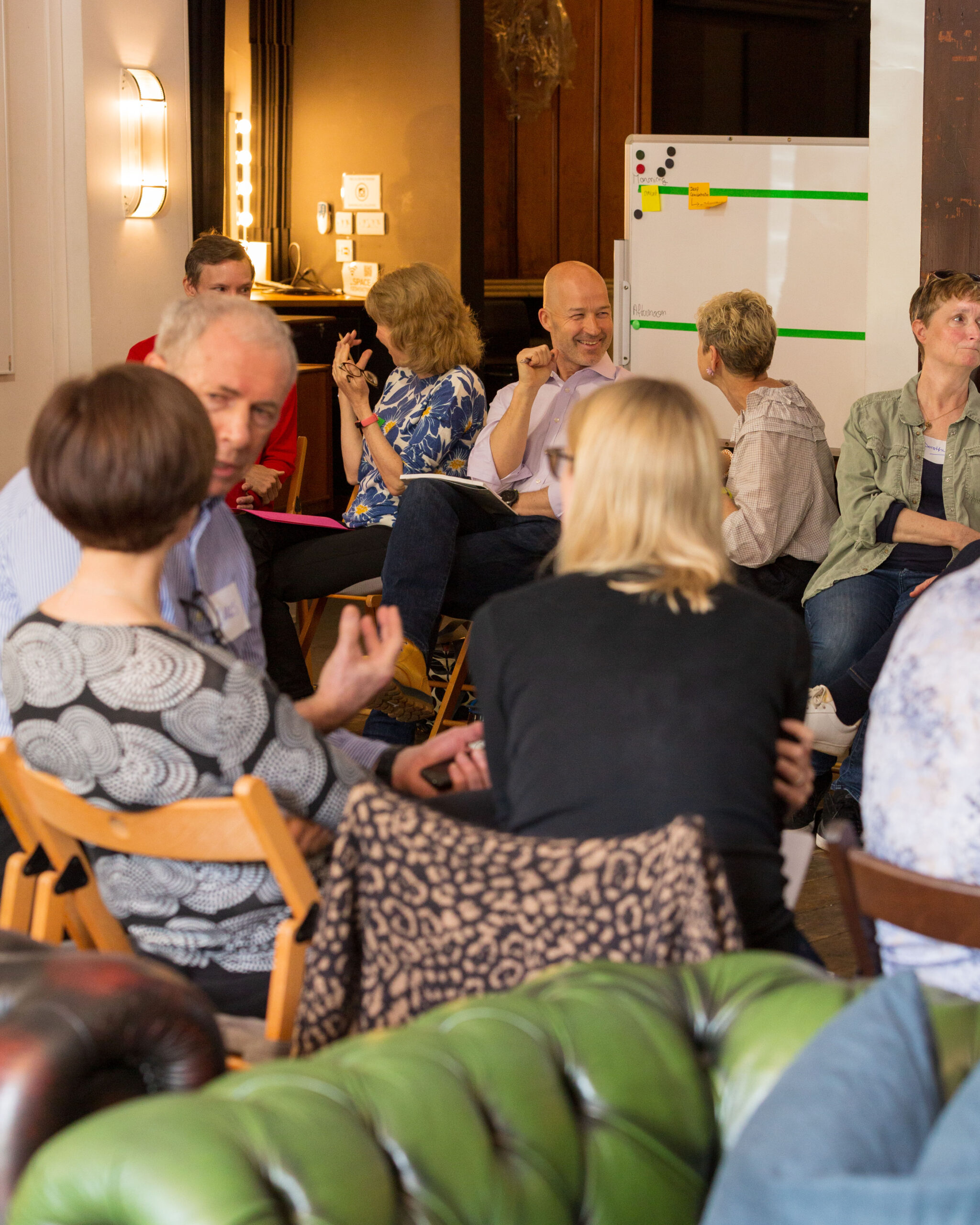
There’s a significant difference between attending a course and being shaped by a learning journey.
In today’s professional world, learning is often consumed in fragments. A workshop here. A module there. A certification collected. The assumption is that knowledge equals capability.
But in relational work — especially in systems coaching — knowledge is only the beginning.
Mastery is built in community.
The Hidden Risk of Learning in Isolation
When you learn alone, or in disconnected modules, something subtle but important happens.
You try the tools.
You experiment with new language.
You test your confidence.
And if it goes well, you feel encouraged.
But if it doesn’t?
If you stumble over language?
If you misread a dynamic?
If a client reacts unexpectedly?
It is incredibly easy to close the laptop, withdraw quietly, and decide — consciously or not — not to go there again.
Without a consistent cohort around you, mistakes can turn into shame.
And shame turns into avoidance.
That’s how growth stalls.
In isolated learning environments, there is very little support for the moment after the wobble.
And yet in real organisational life, those wobbles are exactly where leadership is required.
Learning Systems Build Recovery, Not Just Skill
When you learn as part of a consistent cohort — a learning system — something entirely different develops.
You are witnessed over time.
The same group sees:
- Your strengths
- Your blind spots
- Your growth edges
- Your breakthroughs
They champion you.
They challenge you.
They hold the boundaries of the work.
They normalise mistakes.
When you try something and it doesn’t land, you don’t disappear.
You recover.
And in recovering, you build capacity.
That capacity — the ability to stay present when things feel uncomfortable or imperfect — is the real skill behind systems coaching.
Because in real teams, you don’t get to close the call and walk away.
You need to stay.
Repair.
Reframe.
Re-engage.
Learning in cohort builds exactly that muscle.
Why ORSC Is Designed as a Journey
Organization and Relationship Systems Coaching (ORSC™) is built on systemic principles. And one of the most important systemic truths is this:
We develop in relationship.
ORSC is not simply about learning tools. It is about becoming someone who can hold complexity, navigate tension, and work skilfully with conflict and alignment.
That level of embodiment requires:
- Repetition over time
- Psychological safety
- Real practice
- Reflection in community
This is why, at CRR UK, we sell ORSC as a complete series rather than individual standalone modules.
Individual modules introduce powerful concepts.
The series builds integration.
It is through staying with the same cohort — moving through the material together — that trust deepens. And when trust deepens, people cross edges they would never cross in a fragmented learning experience.
Edges are where transformation happens.
But no one crosses them alone.
The Role of Mentoring and Reintegration
One of the most valuable parts of our ORSC series is what happens between modules.
After each module, we hold mentoring calls where the cohort reconvenes. Participants return having tried the tools in real client and organisational settings. They bring:
- Successes
- Missteps
- Unexpected reactions
- Moments of discomfort
- Moments of magic
And together, they unpack it.
This is where the learning accelerates.
Not because the theory is repeated — but because the lived experience is integrated.
Someone shares how they struggled with contracting language.
Another shares how a Designed Team Alliance shifted a stuck team.
Another describes freezing in a moment of conflict.
And the cohort works with it.
This collective reflection strengthens confidence and clarity in a way that isolated learning never can.
It turns theory into instinct.
Confidence Comes From Being Seen Over Time
One of the greatest benefits of cohort learning is the confidence that grows from being known.
When the same group sees you develop across months, they reflect back your evolution.
They notice when your language sharpens.
They highlight when you hold neutrality more skilfully.
They call out when you step back into old habits.
That ongoing feedback builds self-trust.
And self-trust is essential in systems coaching.
Because when you are working with complex relational dynamics, you cannot rely on scripts. You rely on presence, discernment and embodied understanding.
Those qualities develop in community.
A Different Model of Professional Development
There is nothing inherently wrong with modular learning. It offers flexibility and access.
But modular consumption is not the same as developmental progression.
At CRR UK, we believe ORSC is a developmental pathway.
Fundamentals opens the lens.
The series builds mastery.
If you move between disconnected cohorts, delay modules indefinitely, or treat each as a standalone experience, you may understand the concepts.
But staying with your learning system is what allows you to embody them.
And embodiment is what makes the difference between knowing the work and being the work.
The Real Return on Investment
When participants complete the full ORSC series within a stable cohort, they don’t just leave with tools.
They leave with:
- Increased resilience when working with conflict
- Greater clarity in systemic thinking
- The ability to recover in live relational moments
- A deeper sense of professional confidence
- A network of peers who have grown alongside them
Most importantly, they leave having experienced what it means to be part of a functioning system.
And that experience changes how they show up everywhere else.
Mastery does not happen in isolation.
It happens in relationship, over time.
If you are considering ORSC, don’t just ask which module to take.
Ask who you want to become — and whether you are willing to stay long enough for that transformation to take root.
Because systems coaching is not a course you complete.
It is a practice you grow into.
Join us for the Spring Series
Join us for the May Virtual Fundamentals